Why I Started My Kitten on Omega-3 Before Any Symptoms Ever Showed Up
Why I Started My Kitten on Omega-3 Before Any Symptoms Ever Showed Up

By Dr. Amir Anwary
Veterinarian & Founder, Vets2Pets
By Dr. Amir Anwary
Veterinarian & Founder,
Vets2Pets
By Dr. Amir Anwary
Veterinarian & Founder, Vets2Pets

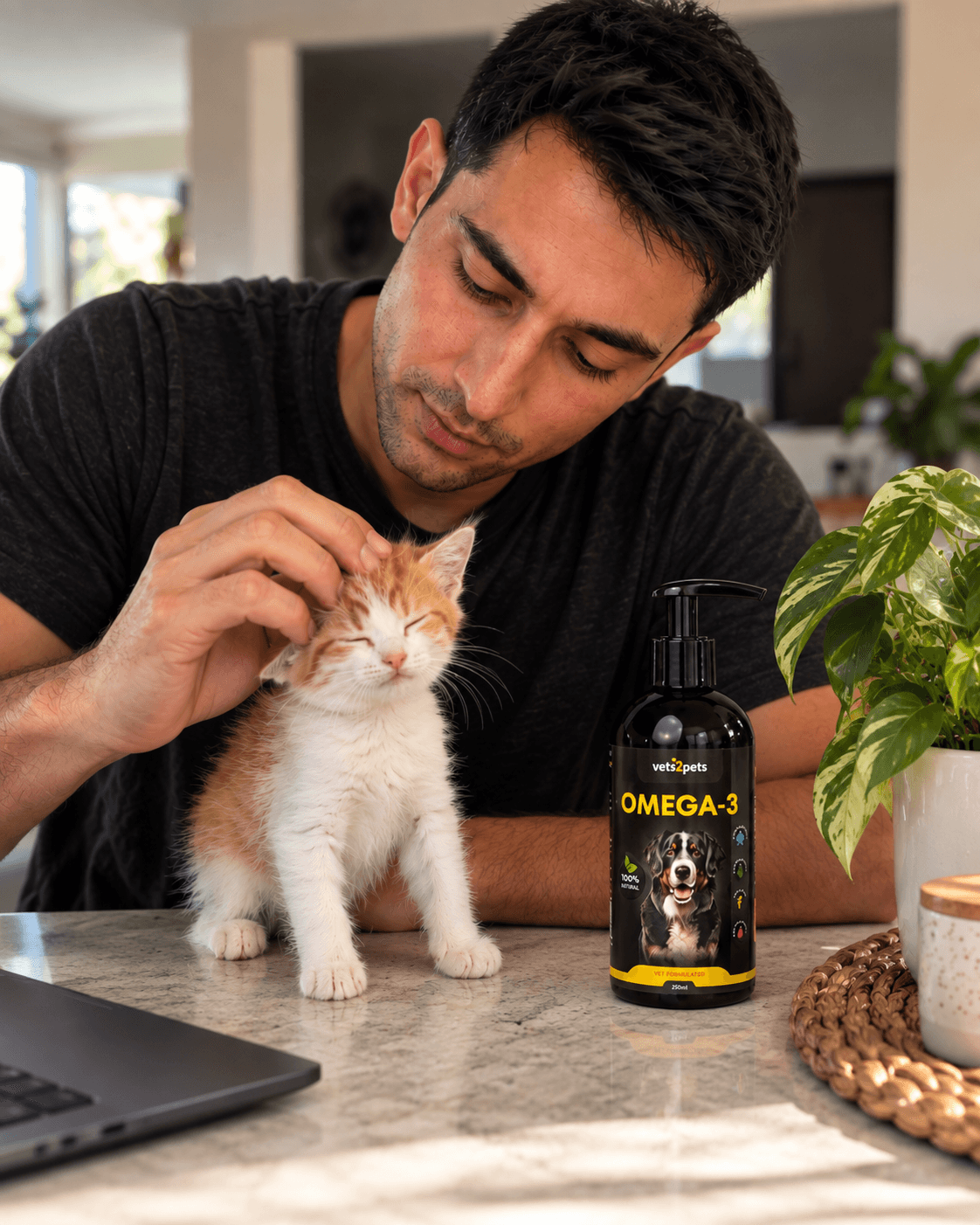
Archie was maybe four months old the first time I mixed Omega-3 into his food. No symptoms. No diagnosis. Nothing wrong with him at all. My clients ask me about this constantly: why start so early, on a kitten who's perfectly healthy?
Here's my honest answer: because the thing I worry about most in cats doesn't announce itself early. And by the time it does, you've lost the years when doing something simple would have mattered most.
Archie was maybe four months old the first time I mixed Omega-3 into his food. No symptoms. No diagnosis. Nothing wrong with him at all. My clients ask me about this constantly: why start so early, on a kitten who's perfectly healthy?
Here's my honest answer: because the thing I worry about most in cats doesn't announce itself early. And by the time it does, you've lost the years when doing something simple would have mattered most.
1. "Complete and balanced" wasn't built for this question
1. "Complete and balanced" wasn't built for this question
Most cat owners buy a good food, watch their cat thrive, and reasonably assume the nutrition question is closed. But "complete and balanced" is an adequacy standard, it tells you a food clears a minimum bar across nutrients, not that any one nutrient is dosed to optimise your cat's long-term health. AAFCO's own nutrient profile, which cover both dogs and cats set a maximum omega-6-to-omega-3 ratio, but no minimum for EPA and DHA, the two fatty acids that actually do the work.
It matters even more for cats than for dogs. Cats are especially limited in how efficiently they convert plant-based Omega-3 (ALA) into usable EPA and DHA, so if the source on the label is plant-derived, the number on the bag may not reflect what your cat's body can actually use.
I'm not telling you to change your cat's food. I'm telling you "Omega-3" on a label answers fewer questions than owners assume.
Most cat owners buy a good food, watch their cat thrive, and reasonably assume the nutrition question is closed. But "complete and balanced" is an adequacy standard, it tells you a food clears a minimum bar across nutrients, not that any one nutrient is dosed to optimise your cat's long-term health. AAFCO's own nutrient profile, which cover both dogs and cats set a maximum omega-6-to-omega-3 ratio, but no minimum for EPA and DHA, the two fatty acids that actually do the work.
It matters even more for cats than for dogs. Cats are especially limited in how efficiently they convert plant-based Omega-3 (ALA) into usable EPA and DHA, so if the source on the label is plant-derived, the number on the bag may not reflect what your cat's body can actually use.
I'm not telling you to change your cat's food. I'm telling you "Omega-3" on a label answers fewer questions than owners assume.

2. The stakes, for a cat specifically
2. The stakes, for a cat specifically
Here's why I don't wait. Kidney disease is one of the most common problems I see in older cats — and cats are experts at hiding illness until a problem is well established. I'm not going to tell you Omega-3 treats or prevents kidney disease; no honest vet would say that. What I will tell you is that EPA and DHA are used nutritionally to support kidney function, a healthy inflammatory response, skin, coat, heart and brain — and that support means more if it's already in place before anything goes wrong, not introduced after.
Here's why I don't wait. Kidney disease is one of the most common problems I see in older cats — and cats are experts at hiding illness until a problem is well established. I'm not going to tell you Omega-3 treats or prevents kidney disease; no honest vet would say that. What I will tell you is that EPA and DHA are used nutritionally to support kidney function, a healthy inflammatory response, skin, coat, heart and brain — and that support means more if it's already in place before anything goes wrong, not introduced after.
3. Why I started Archie young, not later
Cats can be genuinely difficult about new things introduced into their routine — new smells, new textures, sudden changes. Starting Omega-3 when Archie was a kitten meant it became part of his normal food, not a fight I'd have to win later with an older, more particular cat. My practical advice to every cat owner: introduce it slowly, mix it into wet food, and start as young as you reasonably can — you're not treating anything, you're building a habit while it's still easy.

4. What I actually use
Vets2Pets Omega-3 for Cats is a marine-sourced formula — roughly 35% Omega-3, including meaningful levels of EPA and DHA — built to mix easily into wet food. It's supportive nutrition alongside your vet's care, not a replacement for it, and it won't be protected from everyday wear the way a fresh, well-stored oil is unless it's actually formulated to resist oxidation — which is worth asking about for any omega-3 product, not just ours.

You might be thinking...
"My cat's food is already complete and balanced." It is — that just doesn't tell you the EPA+DHA dose your cat is getting. Checking the label takes thirty seconds.
"My cat is young and totally healthy." That's exactly when I'd start. This is daily support while your cat is well, not a treatment once something's wrong.
"Isn't fish oil all the same?" Not quite — source, concentration and freshness all vary. "Omega-3" on a label is a category, not a guarantee.

The bottom line
I can't promise Archie a guaranteed number of years, and no vet honestly can. What I can do is stop waiting for a problem to justify supporting the organs and systems I already know are at risk in cats — while he's still young enough that it's just part of his routine, not a response to a diagnosis.
This article is for general educational purposes and is not a substitute for individual veterinary advice. Every dog is different — talk to your vet before starting any new supplement, especially if your dog is pregnant, nursing, elderly, or on existing medication.
Vets2Pets products are formulated to support general wellbeing and are not intended to diagnose, treat, cure, or prevent disease. Individual results vary.
3. Why I started Archie young, not later
3. Why I started Archie young, not later
Cats can be genuinely difficult about new things introduced into their routine — new smells, new textures, sudden changes. Starting Omega-3 when Archie was a kitten meant it became part of his normal food, not a fight I'd have to win later with an older, more particular cat. My practical advice to every cat owner: introduce it slowly, mix it into wet food, and start as young as you reasonably can — you're not treating anything, you're building a habit while it's still easy.
Vets2Pets Omega-3 for Cats is a marine-sourced formula — roughly 35% Omega-3, including meaningful levels of EPA and DHA — built to mix easily into wet food. It's supportive nutrition alongside your vet's care, not a replacement for it, and it won't be protected from everyday wear the way a fresh, well-stored oil is unless it's actually formulated to resist oxidation — which is worth asking about for any omega-3 product, not just ours.
4. What I actually use
4. What I actually use
Vets2Pets Omega-3 for Cats is a marine-sourced formula — roughly 35% Omega-3, including meaningful levels of EPA and DHA — built to mix easily into wet food. It's supportive nutrition alongside your vet's care, not a replacement for it, and it won't be protected from everyday wear the way a fresh, well-stored oil is unless it's actually formulated to resist oxidation — which is worth asking about for any omega-3 product, not just ours.
Vets2Pets Omega-3 for Cats is a marine-sourced formula — roughly 35% Omega-3, including meaningful levels of EPA and DHA — built to mix easily into wet food. It's supportive nutrition alongside your vet's care, not a replacement for it, and it won't be protected from everyday wear the way a fresh, well-stored oil is unless it's actually formulated to resist oxidation — which is worth asking about for any omega-3 product, not just ours.

You might be thinking...
You might be thinking...
"My cat's food is already complete and balanced." It is — that just doesn't tell you the EPA+DHA dose your cat is getting. Checking the label takes thirty seconds.
"My cat is young and totally healthy." That's exactly when I'd start. This is daily support while your cat is well, not a treatment once something's wrong.
"Isn't fish oil all the same?" Not quite — source, concentration and freshness all vary. "Omega-3" on a label is a category, not a guarantee.
"My cat's food is already complete and balanced." It is — that just doesn't tell you the EPA+DHA dose your cat is getting. Checking the label takes thirty seconds.
"My cat is young and totally healthy." That's exactly when I'd start. This is daily support while your cat is well, not a treatment once something's wrong.
"Isn't fish oil all the same?" Not quite — source, concentration and freshness all vary. "Omega-3" on a label is a category, not a guarantee.

The bottom line
I can't promise Archie a guaranteed number of years, and no vet honestly can. What I can do is stop waiting for a problem to justify supporting the organs and systems I already know are at risk in cats — while he's still young enough that it's just part of his routine, not a response to a diagnosis.
The bottom line
I can't promise Archie a guaranteed number of years, and no vet honestly can. What I can do is stop waiting for a problem to justify supporting the organs and systems I already know are at risk in cats — while he's still young enough that it's just part of his routine, not a response to a diagnosis.