Vet Reveals Why German Shepherds Are Slowing Down Years Before Owners Expect
Vet Reveals Why German Shepherds Are Slowing Down Years Before Owners Expect

By Dr. Amir Anwary
Veterinarian & Founder, Vets2Pets
By Dr. Amir Anwary
Veterinarian & Founder, Vets2Pets
By Dr. Amir Anwary
Veterinarian & Founder,
Vets2Pets

A client sat across from me a few months ago, close to tears. Her German Shepherd had just turned six. "He sprinted after a ball like he always does," she said, "and came back limping. He's six. Isn't he too young for this?"
I hear a version of that sentence often, and I understand exactly why it's frightening. Six doesn't feel like an age where your dog should be hesitating to get up off the floor. But here's what I need every German Shepherd owner to understand: "too young" is doing a lot of work in that sentence, and it isn't backed by what actually happens in this breed.
A client sat across from me a few months ago, close to tears. Her German Shepherd had just turned six. "He sprinted after a ball like he always does," she said, "and came back limping. He's six. Isn't he too young for this?"
I hear a version of that sentence often, and I understand exactly why it's frightening. Six doesn't feel like an age where your dog should be hesitating to get up off the floor. But here's what I need every German Shepherd owner to understand: "too young" is doing a lot of work in that sentence, and it isn't backed by what actually happens in this breed.
A client sat across from me a few months ago, close to tears. Her German Shepherd had just turned six. "He sprinted after a ball like he always does," she said, "and came back limping. He's six. Isn't he too young for this?"
I hear a version of that sentence often, and I understand exactly why it's frightening. Six doesn't feel like an age where your dog should be hesitating to get up off the floor. But here's what I need every German Shepherd owner to understand: "too young" is doing a lot of work in that sentence, and it isn't backed by what actually happens in this breed.
1. The assumption that delays owners the most
1. The assumption that delays owners the most
"He just overdid it." "It's the cold." "He's getting older, that's normal." Every one of those explanations can be true on any given day — which is exactly why a recurring limp, stiffness after rest, or hesitation on stairs gets explained away for months before anyone books an exam.
I'm not here to scare you into thinking every off day is a crisis. I'm here to tell you what I tell my own clients: a limp that keeps coming back is not a one-off, and it deserves an actual look, not a guess.
"He just overdid it." "It's the cold." "He's getting older, that's normal." Every one of those explanations can be true on any given day — which is exactly why a recurring limp, stiffness after rest, or hesitation on stairs gets explained away for months before anyone books an exam.
I'm not here to scare you into thinking every off day is a crisis. I'm here to tell you what I tell my own clients: a limp that keeps coming back is not a one-off, and it deserves an actual look, not a guess.
2. Why German Shepherds specifically — the root cause
2. Why German Shepherds specifically — the root cause
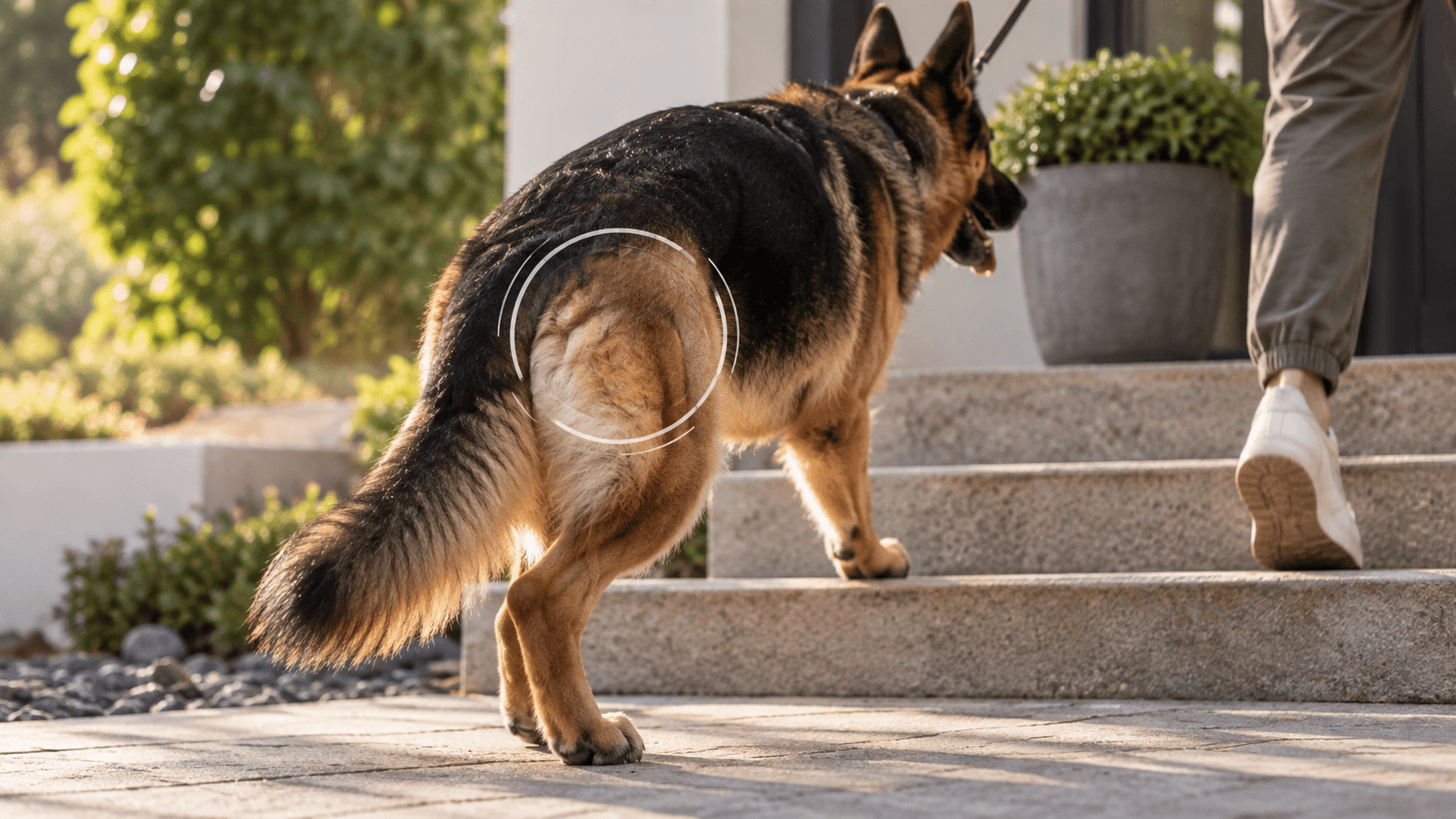
This isn't breed folklore. A study of 775 German Shepherds radiographed at an average age of just 1.55 years found that hip phenotype — the physical shape and fit of the joint — can already be assessed well before a dog is anywhere near "senior."¹ Broader veterinary research on canine hip dysplasia confirms that joint laxity can be detectable in young dogs, while pain and secondary osteoarthritis may only become clinically obvious later.
To be clear about what that does and doesn't mean: it does not mean every young German Shepherd has symptomatic joint disease. It means the structural risk in this breed starts long before the visible signs do — so by the time you see a limp, the joint has often been under strain for a while already.
This isn't breed folklore. A study of 775 German Shepherds radiographed at an average age of just 1.55 years found that hip phenotype — the physical shape and fit of the joint — can already be assessed well before a dog is anywhere near "senior."¹ Broader veterinary research on canine hip dysplasia confirms that joint laxity can be detectable in young dogs, while pain and secondary osteoarthritis may only become clinically obvious later.
To be clear about what that does and doesn't mean: it does not mean every young German Shepherd has symptomatic joint disease. It means the structural risk in this breed starts long before the visible signs do — so by the time you see a limp, the joint has often been under strain for a while already.
3. What owners usually try — and why it gets complicated
3. What owners usually try — and why it gets complicated
By the time an owner reaches out to me, they've often already tried two or three things: fish oil, a glucosamine powder, maybe CBD, occasionally turmeric. Nothing is necessarily wrong with any single one of those — the problem is that stacking disconnected products with no coordinated plan gets expensive, hard to keep track of, and hard to keep your dog actually eating. I've had clients tell me their dog sniffs out a tablet hidden in peanut butter every single time.
"I'm holding something that could help, but I can't get my dog to take it" is one of the most common frustrations I hear — and it's a real barrier, not a minor inconvenience.
By the time an owner reaches out to me, they've often already tried two or three things: fish oil, a glucosamine powder, maybe CBD, occasionally turmeric. Nothing is necessarily wrong with any single one of those — the problem is that stacking disconnected products with no coordinated plan gets expensive, hard to keep track of, and hard to keep your dog actually eating. I've had clients tell me their dog sniffs out a tablet hidden in peanut butter every single time.
"I'm holding something that could help, but I can't get my dog to take it" is one of the most common frustrations I hear — and it's a real barrier, not a minor inconvenience.
"Owners aren't failing their dogs by not knowing which of six supplements to pick. The category is just genuinely confusing. My job is to simplify it, not add another bottle to the shelf."
-Dr. Amir Anwary
"Owners aren't failing their dogs by not knowing which of six supplements to pick. The category is just genuinely confusing. My job is to simplify it, not add another bottle to the shelf."
-Dr. Amir Anwary
4. Two different jobs, one daily routine
4. Two different jobs, one daily routine
This is why I built the MoveMore Bundle around two products with clearly different, complementary roles rather than one product trying to do everything:
Joint Support Powder supports cartilage integrity, connective-tissue function, joint cushioning, joint comfort and everyday mobility.
Omega-3 provides concentrated marine EPA and DHA to support a healthy inflammatory response, joint comfort and mobility.
Put simply: Joint Support supports the structures that help joints move comfortably; Omega-3 supports a healthy inflammatory response. Together, they provide broader daily mobility support in one simple routine — scoop, pump, mix into food, done. I can't promise you a finished clinical trial on the combined bundle — that research doesn't exist yet for any joint bundle on the market — but the ingredient-level evidence behind each role is real, and the simplicity is the point: one weight-based routine instead of a shelf of things to remember.
This is why I built the MoveMore Bundle around two products with clearly different, complementary roles rather than one product trying to do everything:
Joint Support Powder supports cartilage integrity, connective-tissue function, joint cushioning, joint comfort and everyday mobility.
Omega-3 provides concentrated marine EPA and DHA to support a healthy inflammatory response, joint comfort and mobility.
Put simply: Joint Support supports the structures that help joints move comfortably; Omega-3 supports a healthy inflammatory response. Together, they provide broader daily mobility support in one simple routine — scoop, pump, mix into food, done. I can't promise you a finished clinical trial on the combined bundle — that research doesn't exist yet for any joint bundle on the market — but the ingredient-level evidence behind each role is real, and the simplicity is the point: one weight-based routine instead of a shelf of things to remember.

You might be thinking...
You might be thinking...
"My dog is too young for arthritis." German Shepherd owners report limping and hind-leg issues well before what most people consider old age. A recurring limp deserves a look — not panic, just attention.
"I already give a joint supplement." Many owners are already stacking two or three single products to cover different needs. The bundle simplifies that into one routine with two clearly defined roles.
"We tried supplements before and nothing changed." Outcomes vary, and consistency, correct dosing and your dog's specific diagnosis all matter. This isn't an instant painkiller — it's daily nutritional support.
"I'm worried about replacing his medication." You shouldn't, and this doesn't ask you to. This is supportive care that sits alongside your vet's plan — never a substitute for diagnosis or prescribed treatment.
"My dog's food is complete and balanced." It is — and that's a real, important standard. It just doesn't tell you the EPA+DHA dose your dog is getting. The next step is checking the label, not replacing the food.
"Isn't omega-6 bad, then?" No — dogs need both omega-6 and omega-3. This isn't about demonising one fat; it's about whether the overall balance, and the usable amount of EPA+DHA, is enough to support a healthy inflammatory response.
"My dog is young and perfectly healthy." That's exactly the point. This is daily support introduced while your dog is healthy — not a treatment for a problem that's already shown up.
"I already give fish oil." Check the actual EPA+DHA concentration, the source, and how it's been stored. "Fish oil" is a category. What matters is the measurable amount your dog is actually getting.
A note on timing and evidence.
Benefits build with consistent daily use. Some owners may notice mobility changes within several weeks; allow approximately 4–8 weeks before evaluating the routine. Individual results vary. No supplement — ours included — treats, reverses or cures arthritis or hip dysplasia; this is nutritional support within your dog's wider care plan, not a replacement for it.
A note on timing and evidence
Benefits build with consistent daily use. Some owners may notice mobility changes within several weeks; allow approximately 4–8 weeks before evaluating the routine. Individual results vary. No supplement — ours included — treats, reverses or cures arthritis or hip dysplasia; this is nutritional support within your dog's wider care plan, not a replacement for it.
A note on timing and evidence
Benefits build with consistent daily use. Some owners may notice mobility changes within several weeks; allow approximately 4–8 weeks before evaluating the routine. Individual results vary. No supplement — ours included — treats, reverses or cures arthritis or hip dysplasia; this is nutritional support within your dog's wider care plan, not a replacement for it.
The bottom line
Six is not too young to pay attention. It's exactly the age where noticing early, asking your vet the right questions, and putting a simple daily routine in place actually matters — before the limp becomes the only thing you notice about your dog's day.
The bottom line
Six is not too young to pay attention. It's exactly the age where noticing early, asking your vet the right questions, and putting a simple daily routine in place actually matters — before the limp becomes the only thing you notice about your dog's day.
Get started - MoveMore Bundle
Get started - MoveMore Bundle
Joint Support Powder + Omega-3, one daily routine, two complementary roles.
Joint Support Powder + Omega-3, one daily routine, two complementary roles.

Still deciding?
Still deciding?
Talk to your vet about a recurring limp first, then come back. No pressure — just a simpler daily routine when you're ready.
Talk to your vet about a recurring limp first, then come back. No pressure — just a simpler daily routine when you're ready.
Persistent, sudden or severe limping can be a sign of injury or underlying disease and should be assessed by a veterinarian. The MoveMore Bundle provides nutritional support and is not intended to diagnose, treat, cure or prevent disease. Use as directed on the current label and consult your veterinarian before combining supplements with prescribed medication. Do not start, stop or change prescribed treatment without veterinary guidance. Individual results vary.
Persistent, sudden or severe limping can be a sign of injury or underlying disease and should be assessed by a veterinarian. The MoveMore Bundle provides nutritional support and is not intended to diagnose, treat, cure or prevent disease. Use as directed on the current label and consult your veterinarian before combining supplements with prescribed medication. Do not start, stop or change prescribed treatment without veterinary guidance. Individual results vary.