New Research Reveals a Critical Gap in Even 'Premium' Dog Food
New Research Reveals a Critical Gap in Even 'Premium' Dog Food

By Dr. Amir Anwary
Veterinarian & Founder, Vets2Pets
By Dr. Amir Anwary
Veterinarian & Founder, Vets2Pets
By Dr. Amir Anwary
Veterinarian & Founder,
Vets2Pets
Before you read another word of this — go find your dog's food bag. I'll wait.
Got it? Good. Because in a minute I'm going to ask you to turn it around, and I want you standing there, label in hand, when you do.
I'm a vet. I'm also the guy who reads pet food labels in the aisle like other people read wine labels — turning bags over, doing the math, occasionally annoying my own family by taking too long to buy dog food. So when I tell you that most owners who buy "premium," "complete and balanced" food are doing everything they've been told to do — and still missing something — I need you to hear the next part carefully, because it is not what you think.
Before you read another word of this — go find your dog's food bag. I'll wait.
Got it? Good. Because in a minute I'm going to ask you to turn it around, and I want you standing there, label in hand, when you do.
I'm a vet. I'm also the guy who reads pet food labels in the aisle like other people read wine labels — turning bags over, doing the math, occasionally annoying my own family by taking too long to buy dog food. So when I tell you that most owners who buy "premium," "complete and balanced" food are doing everything they've been told to do — and still missing something — I need you to hear the next part carefully, because it is not what you think.
1. The assumption every good owner makes
1. The assumption every good owner makes
If you buy a well-regarded food, feed it consistently, and your dog looks healthy, you've reasonably assumed the nutrition question is closed. "Premium." "Complete and balanced." "Contains Omega-3." Those words are supposed to mean covered.
Here's the part almost nobody tells owners: "complete and balanced" is a nutritional adequacy standard, not an optimisation standard. It tells you a food meets a minimum bar across dozens of nutrients. It does not tell you how well any single nutrient is dosed for your dog's long-term health.
I want to be precise here, because this is where these articles usually go too far and I refuse to. I am not telling you your dog's food is bad, and I am not telling you to throw it away. I'm telling you that "adequate" and "optimised" are two different questions, and most labels only answer the first one.
If you buy a well-regarded food, feed it consistently, and your dog looks healthy, you've reasonably assumed the nutrition question is closed. "Premium." "Complete and balanced." "Contains Omega-3." Those words are supposed to mean covered.
Here's the part almost nobody tells owners: "complete and balanced" is a nutritional adequacy standard, not an optimisation standard. It tells you a food meets a minimum bar across dozens of nutrients. It does not tell you how well any single nutrient is dosed for your dog's long-term health.
I want to be precise here, because this is where these articles usually go too far and I refuse to. I am not telling you your dog's food is bad, and I am not telling you to throw it away. I'm telling you that "adequate" and "optimised" are two different questions, and most labels only answer the first one.

2. What "complete and balanced" actually guarantees
2. What "complete and balanced" actually guarantees
If you buy a well-regarded food, feed it consistently, and your dog looks healthy, you've reasonably assumed the nutrition question is closed. "Premium." "Complete and balanced." "Contains Omega-3." Those words are supposed to mean covered.
Here's the part almost nobody tells owners: "complete and balanced" is a nutritional adequacy standard, not an optimisation standard. It tells you a food meets a minimum bar across dozens of nutrients. It does not tell you how well any single nutrient is dosed for your dog's long-term health.
I want to be precise here, because this is where these articles usually go too far and I refuse to. I am not telling you your dog's food is bad, and I am not telling you to throw it away. I'm telling you that "adequate" and "optimised" are two different questions, and most labels only answer the first one.
If you buy a well-regarded food, feed it consistently, and your dog looks healthy, you've reasonably assumed the nutrition question is closed. "Premium." "Complete and balanced." "Contains Omega-3." Those words are supposed to mean covered.
Here's the part almost nobody tells owners: "complete and balanced" is a nutritional adequacy standard, not an optimisation standard. It tells you a food meets a minimum bar across dozens of nutrients. It does not tell you how well any single nutrient is dosed for your dog's long-term health.
I want to be precise here, because this is where these articles usually go too far and I refuse to. I am not telling you your dog's food is bad, and I am not telling you to throw it away. I'm telling you that "adequate" and "optimised" are two different questions, and most labels only answer the first one.

3. The consequence you can't see yet
3. The consequence you can't see yet
Here's why I care about this beyond the label technicality. Ageing in dogs is increasingly understood to involve chronic, low-grade inflammation — researchers have started calling the pattern "inflammaging." A 2024 Dog Aging Project pilot study found that several circulating inflammatory markers, including IL-6, IL-8 and TNF-α, were positively associated with age in healthy companion dogs — dogs that looked completely fine.
Read that last part again: healthy dogs. Not sick dogs. Not diagnosed dogs. The pattern shows up before you'd ever notice anything from the outside.
I'm not going to tell you Omega-3 makes dogs live longer — no honest vet would say that about any supplement. What I will tell you is this: the body your dog has at ten was shaped by what you consistently gave it while he still looked perfectly fine at four, five, six. Waiting for the slowdown to start paying attention is waiting too long.
Here's why I care about this beyond the label technicality. Ageing in dogs is increasingly understood to involve chronic, low-grade inflammation — researchers have started calling the pattern "inflammaging." A 2024 Dog Aging Project pilot study found that several circulating inflammatory markers, including IL-6, IL-8 and TNF-α, were positively associated with age in healthy companion dogs — dogs that looked completely fine.
Read that last part again: healthy dogs. Not sick dogs. Not diagnosed dogs. The pattern shows up before you'd ever notice anything from the outside.
I'm not going to tell you Omega-3 makes dogs live longer — no honest vet would say that about any supplement. What I will tell you is this: the body your dog has at ten was shaped by what you consistently gave it while he still looked perfectly fine at four, five, six. Waiting for the slowdown to start paying attention is waiting too long.
4. Lifespan is not the same question as healthspan
4. Lifespan is not the same question as healthspan
I don't want your dog to just reach an impressive number on a birthday cake. I want him still doing the things that make him him — still asking for the walk, still meeting you at the door, still stealing socks — for as many of those years as possible. That's healthspan, and it's a different goal from lifespan.
This is genuinely why I give my own dog, Shelby, an Omega-3 supplement every day, starting well before she showed any sign of slowing down. Not because I panicked about her food. Because I didn't want to wait until there was a problem to start supporting her.
I don't want your dog to just reach an impressive number on a birthday cake. I want him still doing the things that make him him — still asking for the walk, still meeting you at the door, still stealing socks — for as many of those years as possible. That's healthspan, and it's a different goal from lifespan.
This is genuinely why I give my own dog, Shelby, an Omega-3 supplement every day, starting well before she showed any sign of slowing down. Not because I panicked about her food. Because I didn't want to wait until there was a problem to start supporting her.

The bottom line
"The pet-food industry's job is to sell food your dog can eat safely, every day, for years. That's a real and valuable job. It just isn't the same job as optimising your dog's next ten years — and nobody ever told owners those were two different things."
-Dr. Amir Anwary
The bottom line
"The pet-food industry's job is to sell food your dog can eat safely, every day, for years. That's a real and valuable job. It just isn't the same job as optimising your dog's next ten years — and nobody ever told owners those were two different things."
-Dr. Amir Anwary
5. The 30-second label test I want you to run
5. The 30-second label test I want you to run
Here's the practical part. Not every "Omega-3" claim answers the same question. Some of it comes from plant sources as ALA; what actually does the inflammatory-response work is the long-chain marine pair, EPA and DHA — and research on companion-animal nutrition is clear that source and balance both matter, not just the word "omega-3" on the front of the bag.
So go back to that bag in your hand. Turn it over. Ask three questions:
Can you find EPA listed?
Can you find DHA listed?
Can you see an actual amount — not just the word "omega-3" floating in an ingredients list?
If you can't answer yes to all three, you don't have a crisis. You have information you didn't have five minutes ago.
Here's the practical part. Not every "Omega-3" claim answers the same question. Some of it comes from plant sources as ALA; what actually does the inflammatory-response work is the long-chain marine pair, EPA and DHA — and research on companion-animal nutrition is clear that source and balance both matter, not just the word "omega-3" on the front of the bag.
So go back to that bag in your hand. Turn it over. Ask three questions:
Can you find EPA listed?
Can you find DHA listed?
Can you see an actual amount — not just the word "omega-3" floating in an ingredients list?
If you can't answer yes to all three, you don't have a crisis. You have information you didn't have five minutes ago.
EPA and DHA are also chemically fragile — they're highly susceptible to oxidation, and light, heat and oxygen can degrade them over time unless they're specifically protected. Research specific to dog food shows antioxidant strategy directly affects how much EPA and DHA survive storage. That's a manufacturing and shelf-stability constraint, not a conspiracy — but it's one more reason the number on day one isn't always the number your dog is actually eating months later.
EPA and DHA are also chemically fragile — they're highly susceptible to oxidation, and light, heat and oxygen can degrade them over time unless they're specifically protected. Research specific to dog food shows antioxidant strategy directly affects how much EPA and DHA survive storage. That's a manufacturing and shelf-stability constraint, not a conspiracy — but it's one more reason the number on day one isn't always the number your dog is actually eating months later.
6. What I actually give Shelby every day
6. What I actually give Shelby every day
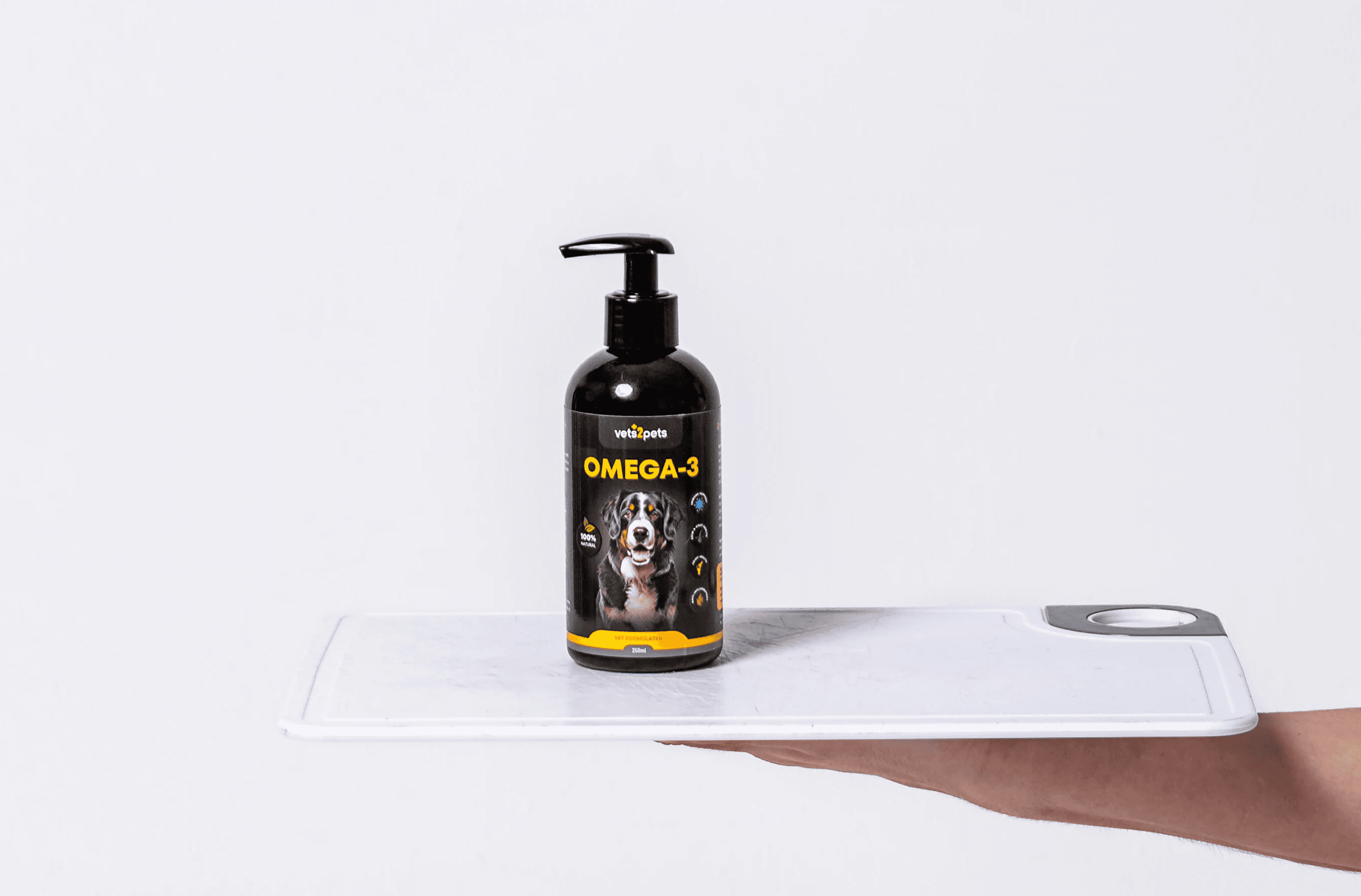
This is why I formulated Vets2Pets Omega-3 the way I did: a clearly labelled, weight-dosed amount of marine-source EPA and DHA, to support a healthy inflammatory response — added as one simple step to her existing food, not a replacement for it.
To be completely clear about what this is and isn't: it will not cure anything, it will not diagnose anything, and I cannot promise it adds a single day to any dog's life. What EPA and DHA are used for, nutritionally, is supporting skin, coat, joints and a normal inflammatory response — every day, quietly, while your dog is still the one chasing the ball instead of watching you throw it.
This is why I formulated Vets2Pets Omega-3 the way I did: a clearly labelled, weight-dosed amount of marine-source EPA and DHA, to support a healthy inflammatory response — added as one simple step to her existing food, not a replacement for it.
To be completely clear about what this is and isn't: it will not cure anything, it will not diagnose anything, and I cannot promise it adds a single day to any dog's life. What EPA and DHA are used for, nutritionally, is supporting skin, coat, joints and a normal inflammatory response — every day, quietly, while your dog is still the one chasing the ball instead of watching you throw it.
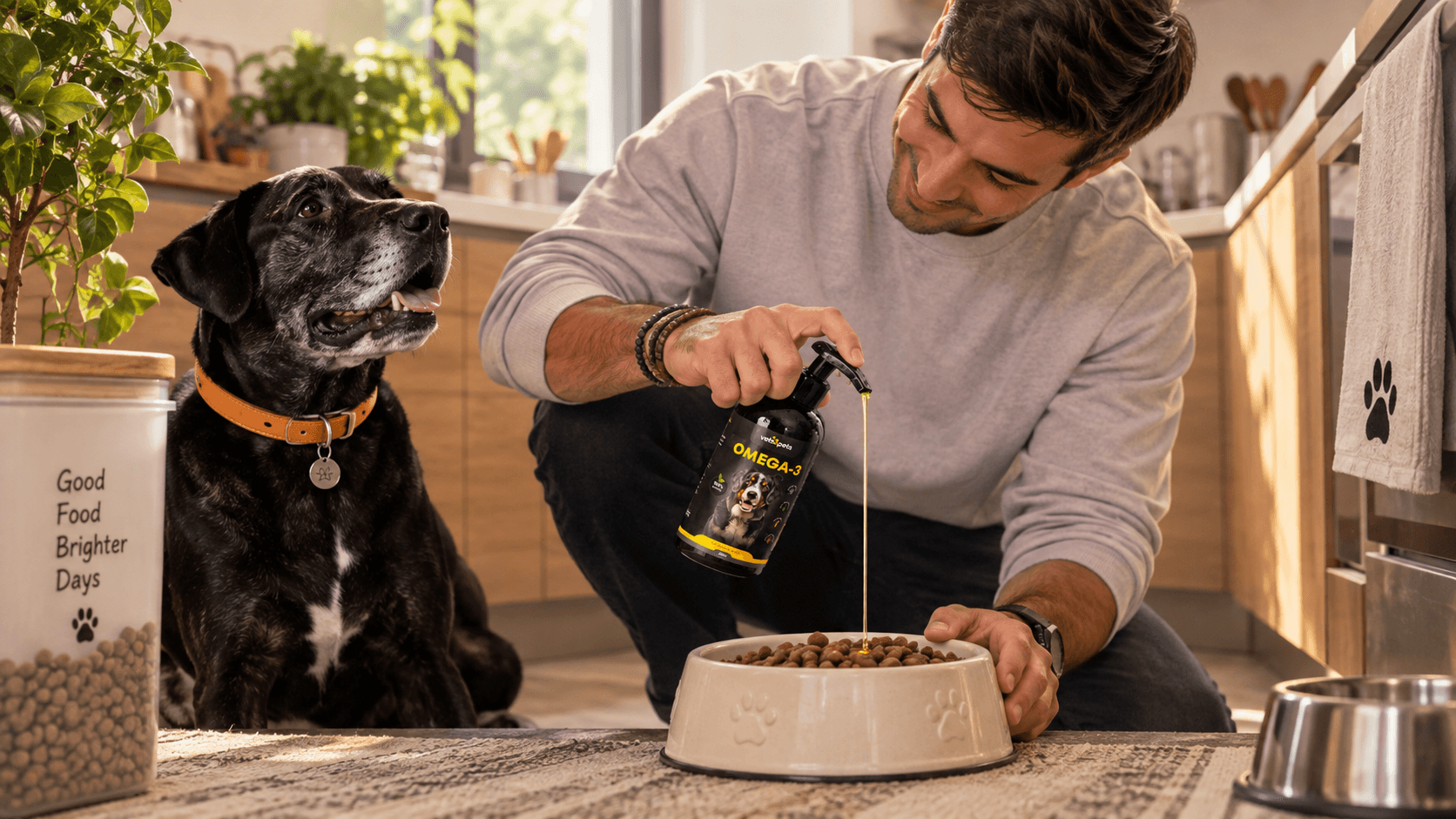
One more thing, because I'd be annoyed if a vet didn't say this to me: don't throw away your dog's food. Don't panic if you can't find EPA and DHA listed. This isn't about fear — it's about checking, once, so you're making an informed choice instead of an assumed one.
One more thing, because I'd be annoyed if a vet didn't say this to me: don't throw away your dog's food. Don't panic if you can't find EPA and DHA listed. This isn't about fear — it's about checking, once, so you're making an informed choice instead of an assumed one.
You might be thinking...
You might be thinking...
"My dog's food is complete and balanced." It is — and that's a real, important standard. It just doesn't tell you the EPA+DHA dose your dog is getting. The next step is checking the label, not replacing the food.
"Isn't omega-6 bad, then?" No — dogs need both omega-6 and omega-3. This isn't about demonising one fat; it's about whether the overall balance, and the usable amount of EPA+DHA, is enough to support a healthy inflammatory response.
"My dog is young and perfectly healthy." That's exactly the point. This is daily support introduced while your dog is healthy — not a treatment for a problem that's already shown up.
"I already give fish oil." Check the actual EPA+DHA concentration, the source, and how it's been stored. "Fish oil" is a category. What matters is the measurable amount your dog is actually getting.
"My dog's food is complete and balanced." It is — and that's a real, important standard. It just doesn't tell you the EPA+DHA dose your dog is getting. The next step is checking the label, not replacing the food.
"Isn't omega-6 bad, then?" No — dogs need both omega-6 and omega-3. This isn't about demonising one fat; it's about whether the overall balance, and the usable amount of EPA+DHA, is enough to support a healthy inflammatory response.
"My dog is young and perfectly healthy." That's exactly the point. This is daily support introduced while your dog is healthy — not a treatment for a problem that's already shown up.
"I already give fish oil." Check the actual EPA+DHA concentration, the source, and how it's been stored. "Fish oil" is a category. What matters is the measurable amount your dog is actually getting.
The bottom line
I'm not telling you the system is lying to you. I'm telling you it was built to solve a different problem than the one you're trying to solve. Commercial food has to be safe, consistent, shelf-stable and affordable at scale — those are genuinely hard, genuinely valuable engineering problems. They are just not the same problem as "what does my individual dog need to feel like himself at twelve."
That second question is yours to ask. The label test takes thirty seconds. What you do with the answer is up to you — but now, at least, you're not assuming.
The bottom line
I'm not telling you the system is lying to you. I'm telling you it was built to solve a different problem than the one you're trying to solve. Commercial food has to be safe, consistent, shelf-stable and affordable at scale — those are genuinely hard, genuinely valuable engineering problems. They are just not the same problem as "what does my individual dog need to feel like himself at twelve."
That second question is yours to ask. The label test takes thirty seconds. What you do with the answer is up to you — but now, at least, you're not assuming.
Ready to check the gap in your dog's bowl?
Ready to check the gap in your dog's bowl?
Get Vets2Pets Omega-3 — EPA and DHA, clearly labelled, weight-dosed.
Get Vets2Pets Omega-3 — EPA and DHA, clearly labelled, weight-dosed.
These statements have not been evaluated by [the relevant regulatory authority]. Vets2Pets Omega-3 is not intended to diagnose, treat, cure or prevent any disease, and no supplement can guarantee lifespan. Individual results vary. This article describes general nutritional science and is not a substitute for advice from your own veterinarian — please consult them before starting any new supplement, particularly if your dog is pregnant, nursing, or on prescription medication. Authentic Vets2Pets products are sold only through vets2pets.com and our verified partners.
These statements have not been evaluated by [the relevant regulatory authority]. Vets2Pets Omega-3 is not intended to diagnose, treat, cure or prevent any disease, and no supplement can guarantee lifespan. Individual results vary. This article describes general nutritional science and is not a substitute for advice from your own veterinarian — please consult them before starting any new supplement, particularly if your dog is pregnant, nursing, or on prescription medication. Authentic Vets2Pets products are sold only through vets2pets.com and our verified partners.